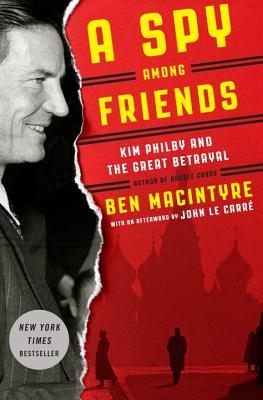
Ben Macintyre’s A Spy Among Friends tells the story of Kim Philby, one of the most consequential traitors of the twentieth century, and the intimate friendships that allowed him to betray his country for decades without suspicion. Philby was a senior officer in British intelligence — MI6 — and simultaneously a Soviet spy, passing secrets to Moscow from the 1930s until his defection to the Soviet Union in 1963. Macintyre’s central argument is not simply that Philby was a brilliant deceiver, but that the culture of the British establishment — built on class loyalty, old-boy networks, and a gentleman’s presumption of trust — made his betrayal both possible and almost inevitable. The book focuses especially on Philby’s closest friend, Nicholas Elliott, a fellow MI6 officer who never once doubted him, and whose personal devastation upon finally learning the truth gives the book much of its emotional weight.
Macintyre writes with the pacing and texture of a thriller, weaving together espionage history, character study, and social commentary. He draws on declassified files, interviews, and memoirs to reconstruct scenes with novelistic vividness, while maintaining a journalist’s care for evidence. The result is a book that works on multiple levels: as a portrait of Cold War espionage, as an anatomy of British class and clubbishness, and as a meditation on friendship and betrayal. Macintyre is particularly sharp on how Philby weaponized the codes of his milieu — charm, understatement, shared jokes, school ties — turning the very bonds of loyalty into instruments of deception. Elliott and Philby had been friends for more than twenty years when Elliott finally confronted him in Beirut in 1963; the scene is rendered with quiet, heartbreaking clarity.
The book also traces the American dimension of Philby’s treachery through his friendship with James Angleton, the CIA’s counterintelligence chief, who was so thoroughly taken in by Philby that the relationship arguably warped American intelligence operations for a generation. The damage Philby caused was not just operational — agents betrayed, operations burned — but institutional and psychological, feeding the paranoia that would haunt both MI6 and the CIA long after he was gone.
Key takeaways
-
Class and culture were Philby’s greatest cover. The British establishment’s reflexive trust among men of the same background, schools, and clubs made it nearly unthinkable for colleagues to seriously suspect him, even when warning signs accumulated. Loyalty to one’s friends was treated as more fundamental than institutional vigilance.
-
Nicholas Elliott’s friendship illustrates the human cost of betrayal. Elliott was not a naive man; he was a skilled and experienced intelligence officer. That Philby could deceive him so completely for so long shows how personal affection can override professional judgment — and Elliott’s private grief after the exposure is one of the book’s most affecting threads.
-
James Angleton was both victim and casualty. Philby cultivated the brilliant but credulous young American during his Washington posting, sharing intelligence and lunches at Harvey’s restaurant. After Philby’s exposure, Angleton became so obsessed with the possibility of further Soviet penetration that he effectively paralyzed CIA counterintelligence with mole-hunting paranoia.
-
The Beirut confrontation was deliberately allowed to fail. Macintyre argues — carefully, on the available evidence — that Elliott’s 1963 confrontation with Philby in Beirut may have been arranged in a way that gave Philby the opportunity to defect rather than face a public trial that would have embarrassed the establishment and MI6 itself. The British state may have found his disappearance convenient.
-
Philby’s ideology was formed early and never wavered. He was recruited as a Cambridge communist in the 1930s, at a moment when Soviet communism seemed to many idealistic young men the only answer to fascism. Unlike some of his contemporaries, his commitment to the Soviet cause endured through the purges, the Hitler-Stalin pact, and the Cold War — though his life in Moscow proved a disillusioning anticlimax.
-
Spy fiction and spy reality blur productively in the book. Macintyre notes that John le Carré, who worked in MI6 and knew both Philby and Elliott, drew on this world directly. The emotional betrayal at the heart of le Carré’s fiction — the idea that the real enemy may be the man you trust most — was not invented but observed.
-
The damage from the Cambridge spy ring was never fully calculable. Because Philby had access to so much for so long, British and American intelligence could never be certain what had been compromised. The uncertainty itself became a kind of ongoing wound, corroding confidence and complicating operations for decades.