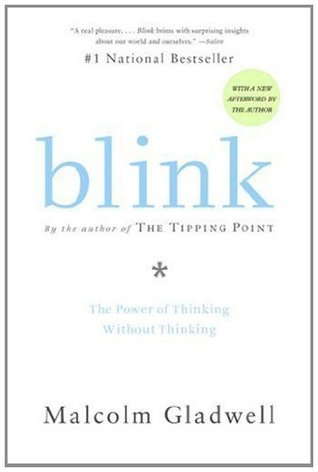
Malcolm Gladwell’s Blink is an exploration of rapid cognition — the mysterious mental processes that operate below the surface of conscious thought and allow human beings to make snap judgments with startling accuracy. Gladwell argues that the split-second decisions we make in the first two seconds of encountering something are not random or reckless, but are often the product of deep experience and unconscious pattern recognition. Drawing on psychology, neuroscience, and a wide range of real-world stories, he makes the case that “thin-slicing” — the ability to extract meaningful conclusions from very thin slices of experience — is a genuine and underappreciated form of intelligence.
The book is structured as a series of vivid case studies that illuminate both the power and the peril of intuitive thinking. Gladwell moves from art experts who instantly detected a forged Greek statue that fooled months of scientific analysis, to a couples therapist who can predict divorce with uncanny accuracy after watching just minutes of conversation, to a military exercise in which a lone general defeated the entire U.S. war machine by acting on instinct rather than data. Yet Gladwell is equally attentive to the ways rapid cognition can fail — how unconscious bias, stress, and a flood of information can corrupt our instincts and lead to tragic mistakes, such as the police shooting of Amadou Diallo. His prose is warm, accessible, and anecdote-driven, characteristic of his signature style of using surprising stories to illuminate broad psychological principles.
Ultimately, Blink is not a straightforward celebration of gut feeling. Gladwell’s more nuanced argument is that we need to understand when to trust our instincts and when to be suspicious of them — and that, with the right training and awareness, we can learn to manage and improve the quality of our unconscious judgments. The book sits at the intersection of popular science and self-help, urging readers to take the contents of their own minds more seriously, while also recognizing that those minds can be shaped by prejudices they may not even know they hold.
Key takeaways
-
Thin-slicing is a real cognitive skill. The unconscious mind can process a narrow window of experience and extract accurate, meaningful patterns — often outperforming lengthy deliberate analysis, particularly in domains where the decision-maker has deep expertise.
-
Expertise trains the unconscious. The snap judgments of seasoned professionals (art historians, experienced firefighters, master chess players) are reliable precisely because years of practice have loaded their unconscious with refined pattern libraries; intuition is not magic but compressed experience.
-
More information is not always better. Gladwell challenges the assumption that gathering more data leads to better decisions. In many cases, extra information introduces noise, overwhelms judgment, and leads people away from the signal their instincts had already detected.
-
Unconscious bias can hijack rapid cognition. The same machinery that produces brilliant intuition also encodes cultural prejudices. Gladwell uses implicit association tests and examples like racial bias in hiring to show that snap judgments are not neutral — they reflect the environment and stereotypes we have absorbed, often without our awareness.
-
Arousal and stress degrade the thin-slicing process. Under conditions of extreme stress, the mind narrows dramatically. Gladwell examines cases where tunnel vision under pressure caused trained professionals — including police officers — to misread situations with fatal consequences, arguing that managing arousal is essential to sound rapid judgment.
-
We can intervene in our unconscious. Rather than simply accepting our instincts as fixed, Gladwell suggests that changing the environment, reducing stress, and deliberately exposing ourselves to counter-stereotypical information can recalibrate unconscious responses and produce better snap judgments over time.
-
The “locked door” problem. One of the book’s recurring themes is that people often cannot explain why they know something intuitively — introspection can actually interfere with performance. Asking someone to articulate an instinctive judgment sometimes causes them to lose access to the very knowledge that made the judgment reliable in the first place.