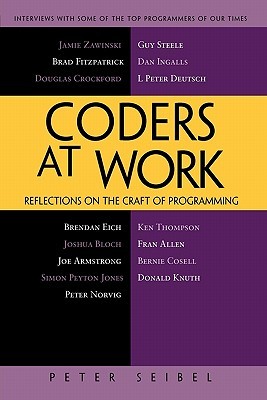
Peter Seibel’s Coders at Work is a collection of in-depth interviews with fifteen of the most accomplished programmers and computer scientists of the modern era, including figures such as Jamie Zawinski, Donald Knuth, Ken Thompson, Fran Allen, Simon Peyton Jones, and Guy Steele, among others. Seibel, himself a programmer and the author of practical coding books, conducts each conversation with the curiosity of a peer rather than the detachment of a journalist, allowing subjects to speak at length about their careers, their philosophies of software design, and the craft of programming as they have lived it across decades. The result is less a how-to manual than an oral history of a discipline still young enough that many of its founding figures are still alive and reflective.
The book does not push a single thesis so much as it surfaces recurring themes through the accumulation of voices. Nearly every interviewee grapples with questions about what makes code readable, how to debug effectively, whether computer science education is preparing the next generation well, and what it means to write software that endures. There is a consistent reverence for simplicity and a corresponding suspicion of unnecessary complexity, though the interviewees disagree sharply on languages, methodologies, and the role of formal methods. Seibel is a careful and patient interviewer who rarely imposes his own views, letting contradictions stand and allowing each programmer’s personality — whether Knuth’s meticulous perfectionism or Zawinski’s scrappy pragmatism — to come through clearly.
What makes Coders at Work distinctive is how honestly its subjects discuss failure, uncertainty, and the limits of their own understanding. These are not triumphalist profiles. Programmers describe bugs they never solved, projects that went sideways, and code they look back on with embarrassment. The book ultimately argues, through accumulation rather than assertion, that great programming is less about raw intelligence than about temperament: curiosity, humility, the willingness to read other people’s code carefully, and the discipline to keep systems as simple as the problem allows.
Key takeaways
-
Reading code is as important as writing it. Nearly every interviewee emphasizes that learning to read and understand unfamiliar codebases — including bad or legacy code — is an underrated and underteached skill that separates good programmers from great ones.
-
Debugging is a craft in itself. Subjects describe debugging not as a mechanical process but as a kind of detective work requiring hypothesis formation, systematic elimination, and deep intuition built over years. Many have strong, idiosyncratic personal methods they have refined over decades.
-
Simplicity is the highest virtue. Across wildly different backgrounds and language preferences, the interviewees converge on a distrust of complexity for its own sake. Good systems are ones that can be understood, held in a single mind, and modified without cascading surprises.
-
Formal methods and proofs occupy an ambiguous place in practice. While several interviewees — particularly those from academic backgrounds — advocate for more rigorous mathematical approaches to software correctness, others are skeptical that such methods scale to real-world software development, revealing an enduring tension in the field.
-
The industry has largely failed to learn from its own history. Multiple programmers express frustration that software development repeatedly reinvents solutions to solved problems, ships buggy products as a matter of course, and rarely treats reliability with the seriousness that other engineering disciplines demand.
-
Great programmers are voracious and self-directed learners. The career paths described are rarely linear or institutionally guided. Most subjects taught themselves extensively, sought out difficult problems, and credit curiosity and persistence over formal training or native talent.
-
The culture and conditions of programming matter enormously. Several interviewees reflect on what made particular teams or organizations — Bell Labs, early Netscape, Xerox PARC — unusually productive, pointing to autonomy, peer respect, and freedom from premature process as common factors.