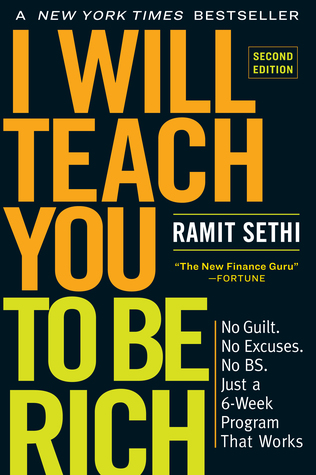
Ramit Sethi’s I Will Teach You to Be Rich is a personal finance guide aimed squarely at young adults in their twenties and thirties who feel overwhelmed, guilty, or simply bored by conventional money advice. First published in 2009 and updated in 2019, the book takes a deliberately irreverent tone — Sethi is blunt, funny, and occasionally combative, dismissing the hand-wringing that dominates most financial self-help in favor of concrete, automatable systems. His central argument is that getting your financial life in order doesn’t require obsessing over every latte you buy; it requires setting up the right accounts, automating your savings and investments, and then largely forgetting about it so you can spend freely on the things you genuinely love.
The book is structured as a six-week program moving through credit cards, bank accounts, investment accounts, conscious spending, and automation. Sethi is a strong advocate for using credit cards strategically to harvest rewards while paying balances in full, for opening high-yield savings accounts and low-cost index fund accounts, and for negotiating fees and interest rates with financial institutions — something most people never try. His “Conscious Spending Plan” is a centerpiece of the book: rather than a restrictive budget, it allocates income across fixed costs, investments, savings goals, and guilt-free spending, explicitly encouraging readers to spend lavishly on whatever they value most as long as the big financial levers are already pulling in the right direction.
Key takeaways
-
Automation is the foundation of financial success. Sethi argues that willpower and discipline are unreliable; the real solution is setting up automatic transfers so that money flows to investments and savings accounts before you ever see it, removing the need for constant decision-making.
-
Credit cards, used correctly, are powerful tools. Rather than avoiding credit cards out of fear, Sethi encourages readers to pick cards with strong rewards, pay them off in full every month, and call to negotiate lower interest rates or waived fees — habits that build credit and generate real value.
-
The Conscious Spending Plan over traditional budgeting. Instead of tracking every purchase, Sethi recommends allocating your income into four buckets — fixed costs (~50–60%), investments (~10%), savings goals (~5–10%), and guilt-free spending — then automating the first three so the remainder can be spent without anxiety.
-
Start investing early in low-cost index funds; don’t try to beat the market. Sethi is a firm believer in target-date retirement funds and broad index funds over stock-picking or actively managed funds, emphasizing that compound growth over decades matters far more than finding the “perfect” investment.
-
Negotiate everything. From credit card APRs to bank fees to salary, most people leave money on the table simply by not asking. Sethi provides scripts for common negotiation calls and frames negotiating as a skill that pays outsized dividends with relatively little effort.
-
Big wins beat small cuts. Cutting out minor indulgences produces marginal gains, but optimizing the big financial decisions — housing costs, car purchases, salary, and automated investing — can be worth tens of thousands of dollars over time. Sethi urges readers to focus energy where it actually moves the needle.
-
A “rich life” is personal, not prescriptive. Underlying all the tactical advice is a philosophical point: money is a means to live the life you actually want, and each person’s version of that is different. The goal isn’t frugality for its own sake but aligning your spending with your genuine values and priorities.