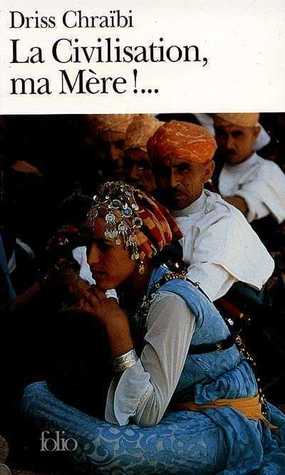
Driss Chraïbi’s La civilisation, ma mère!… (1972) is a bittersweet, often wildly comic novel set in Morocco during the mid-twentieth century, tracing the awakening of a traditional Moroccan woman to the modern world around her. The unnamed mother has spent her entire life enclosed within the domestic space of the family home, sheltered from newspapers, radio, and the rhythms of the outside world by a well-meaning but patriarchal husband. The novel is narrated by her two sons, Nagib and the unnamed younger brother, who become the unlikely agents of her education and emancipation, smuggling modernity into the household one object at a time — a radio, a telephone, a washing machine — each of which sends the mother into raptures of wonder and sets off a chain of comic, tender, and ultimately transformative events.
The book is divided into two parts, the first dominated by the playful, boisterous voice of Nagib, who recounts with slapstick delight the mother’s successive encounters with technology and the wider world. The second part shifts in register, becoming more politically charged as the mother’s personal liberation becomes entangled with the broader struggle for Moroccan independence from French colonialism. Chraïbi’s prose moves fluidly between farce and lyricism, between warm family comedy and pointed social critique. The mother, initially an almost mythic figure of domestic confinement, gradually becomes the novel’s moral and political center — a woman who, once she begins to see the world, cannot stop demanding more of it. Chraïbi, writing from a position of genuine ambivalence about both Western modernity and Arab tradition, uses her journey to interrogate what “civilization” really means and for whom progress is intended.
Key takeaways
-
The mother as symbol and subject: The unnamed mother functions simultaneously as an individual character and as an allegorical figure for colonized, tradition-bound societies awakening to new possibilities. Her transformation from sequestered housewife to politically engaged woman mirrors Morocco’s own journey toward self-determination.
-
Technology as liberation: Each new domestic technology — the radio, the iron, the telephone — is presented not as a symbol of Western superiority but as a doorway through which the mother accesses language, music, news, and ultimately a sense of her own agency. Chraïbi treats these encounters with gentle comedy while insisting on their genuine stakes.
-
Two narrative voices, two tones: The structural split between Nagib’s raucous first-person narration in Part One and the more somber, reflective second part enacts a tonal argument — that awakening begins in laughter and play but must eventually reckon with history, power, and loss.
-
Critique of patriarchy from within: The father is not a villain but a man of his time, loving in his way yet oblivious to the prison he has constructed around his wife. Chraïbi’s critique of patriarchal domestic arrangements is sharp but never simplistic, acknowledging affection and complicity alongside constraint.
-
Colonialism and “civilization” as contested terms: The novel’s ironic title points to Chraïbi’s central provocation — that the French colonial project justified itself in the name of civilization while suppressing the very populations it claimed to uplift. The mother’s self-made education exposes the hollowness of that claim.
-
Female solidarity and political action: In the novel’s second half, the mother connects with other women and moves beyond the domestic sphere into collective action, suggesting that genuine social transformation requires the participation of those most systematically excluded from public life.
-
Humor as a literary and political tool: Chraïbi deploys comedy not to defuse the seriousness of his themes but to make them accessible and to honor the resilience of ordinary people navigating extraordinary historical change. The mother’s infectious delight in discovery is itself a form of resistance.