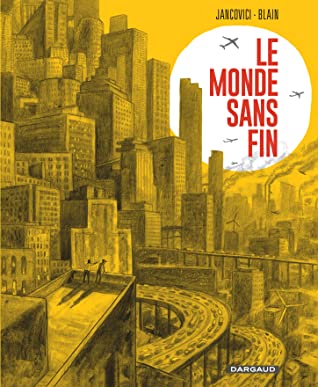
Le monde sans fin is a graphic novel written by Jean-Marc Jancovici and drawn by Christophe Blain, published in 2021. Jancovici, a French engineer and climate expert known for his work on carbon accounting and energy transition, uses the accessible format of the bande dessinée to lay out what he considers the defining challenge of our civilization: the collision between humanity’s insatiable appetite for energy and the physical limits of the planet. The book blends rigorous data with striking visual metaphors, making complex thermodynamic and ecological concepts available to a broad audience. Blain’s illustrations give warmth and humor to what could easily be an arid technical lecture, while Jancovici himself appears as a character throughout, fielding questions, riding planes, and confronting his own contradictions.
The central argument of the book is that modern prosperity is not primarily a product of human ingenuity or financial capital — it is a product of fossil fuels. Jancovici introduces the concept of “energy slaves”: the idea that each barrel of oil or ton of coal effectively replaces hundreds of hours of human muscular labor. Industrial societies have grown accustomed to commanding thousands of these invisible slaves, and the entire architecture of our economy — food production, transportation, healthcare, urban life — rests on their availability. The authors walk through the history of energy use, the mechanics of climate change, the inadequacy of most proposed solutions, and the grim arithmetic of what decarbonization would actually require. The tone is neither apocalyptic nor reassuring; it is, above all, insistent on honesty about the scale of the problem.
Key takeaways
-
Energy slaves as a conceptual lens. Jancovici’s most memorable device is translating energy consumption into human-labor equivalents. An average French citizen, he argues, effectively commands around 400 “energy slaves” working around the clock — a figure that reframes the question of energy sobriety not as a minor lifestyle adjustment but as a civilizational renegotiation.
-
Fossil fuels built modernity. The book insists that the explosion in human population, life expectancy, and material comfort since the Industrial Revolution cannot be disentangled from the combustion of coal, oil, and gas. Renewables and nuclear are discussed seriously, but the authors are skeptical that any combination of alternatives can replicate the energy density and versatility of fossil fuels at the speed and scale required.
-
The climate crisis is a physics problem, not a political one. Carbon dioxide in the atmosphere follows thermodynamic laws indifferent to elections, summits, or pledges. Jancovici is impatient with the idea that good intentions or incremental policy tweaks will be sufficient; the gap between what the science demands and what societies are actually doing is treated as a fundamental, not superficial, contradiction.
-
Aviation and flying as a personal and systemic symbol. A recurring motif is Jancovici’s own discomfort at continuing to fly to conferences about climate change. This self-implication gives the book moral texture and illustrates a broader point: even people who understand the problem are structurally embedded in high-carbon systems, which is precisely what makes voluntary individual change so insufficient.
-
Nuclear power receives an unusually sympathetic treatment. Against the grain of much French environmentalist opinion, Jancovici argues that nuclear energy is indispensable to any serious decarbonization strategy. He addresses fears about waste and accidents with statistical comparisons to the far larger death tolls associated with fossil fuel combustion, urging readers to weigh risks proportionally rather than emotionally.
-
Degrowth is implicit if not always named. The book’s logic pushes toward the conclusion that a society genuinely committed to staying within planetary boundaries would have to accept — and plan for — a significant reduction in material throughput. This is not framed as ascetic virtue but as physical necessity, which makes it more uncomfortable rather than less.
-
The graphic novel format is itself an argument. By choosing a popular, visually driven medium, Jancovici and Blain make the case that these issues are too important to remain confined to technical reports and academic seminars. The book became a massive bestseller in France, suggesting the format succeeded in reaching audiences that conventional climate literature does not.