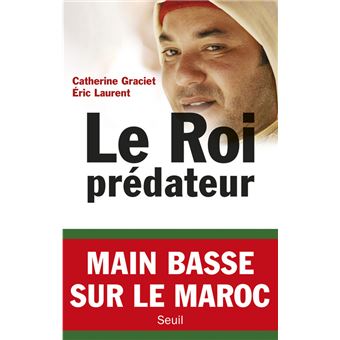
Le Roi prédateur is a political investigation into the reign of Mohammed VI, King of Morocco, written by two French journalists with extensive experience covering North African affairs. Published in 2012, the book presents a sharply critical portrait of the Moroccan monarch, arguing that beneath the carefully managed image of a modernizing, reform-minded ruler lies a system of economic predation in which the king and his inner circle have systematically captured the commanding heights of the Moroccan economy. Far from being a benevolent constitutional sovereign gradually steering his country toward democracy, Mohammed VI is depicted as the central node of a vast patronage network that concentrates wealth and power in the hands of the palace.
The authors draw on interviews, leaked documents, and financial records to trace how the royal holding company SNI (Société Nationale d’Investissement) and affiliated entities have extended the king’s grip across virtually every major sector — from telecommunications and banking to agriculture, real estate, and retail. Graciet and Laurent argue that this economic dominance is inseparable from political control: businessmen, politicians, and civil servants who challenge or simply inconvenience royal interests find themselves sidelined, prosecuted, or ruined, while those who accommodate the palace prosper. The book also scrutinizes Morocco’s international image management, showing how the regime has cultivated influential lobbyists, politicians, and journalists in Europe — particularly in France — to deflect criticism and sustain a narrative of gradual democratization that the authors consider largely fictional.
Key takeaways
-
The king as economic sovereign: Mohammed VI has transformed the monarchy into the dominant economic actor in Morocco, using SNI and a constellation of royal holding structures to acquire controlling stakes across nearly every major industry, making genuine market competition structurally impossible.
-
Crony capitalism enforced from the top: The book documents how contracts, licenses, and regulatory decisions are routinely shaped by proximity to the palace, creating a business environment where loyalty to the monarch is the prerequisite for large-scale commercial success.
-
The myth of reform: Graciet and Laurent contend that the “reformist king” narrative — widely accepted in Western capitals — is a sophisticated public-relations construct. Constitutional amendments and royal speeches about human rights and good governance have not been matched by meaningful transfers of power away from the palace.
-
Repression behind the façade: Despite Morocco’s relatively liberal image compared to some of its neighbors, the book highlights the continued use of surveillance, judicial harassment, and imprisonment against journalists, activists, and opposition figures who push too hard against the limits set by the makhzen (the deep state surrounding the throne).
-
France as an enabler: A recurring theme is the special complicity of the French political and media establishment, which the authors argue has traded critical scrutiny of Rabat for diplomatic convenience, arms contracts, and immigration cooperation — allowing the regime to present itself to European audiences in a consistently flattering light.
-
The Arab Spring as a managed moment: The 2011 protests in Morocco and the king’s subsequent constitutional speech are reread not as genuine concessions but as a carefully calibrated response designed to absorb popular pressure while leaving the fundamental architecture of royal power intact.
-
Wealth inequality as a structural outcome: The authors connect the palace’s economic dominance to Morocco’s persistently high poverty and inequality rates, arguing that the predatory logic of royal capitalism is not an incidental feature of the system but its defining characteristic, one that forecloses the kind of broad-based development that official discourse promises.