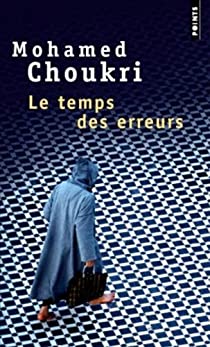
Mohamed Choukri’s Le temps des erreurs — known in Arabic as Zaman al-akhtā’ and in English as Faces — is the second volume of the Moroccan writer’s autobiographical trilogy, following the celebrated Le pain nu (For Bread Alone). Where the first volume chronicled a brutal childhood of poverty, hunger, and survival on the margins of Tangier, this installment carries Choukri into young adulthood, tracing his attempts to build a life as a self-educated writer while remaining entangled in the city’s underworld of bars, brothels, petty crime, and literary ambition. The book is structured loosely as a series of encounters and episodes rather than a linear narrative, giving it a fragmentary, almost hallucinatory texture that mirrors the instability of Choukri’s existence during these years.
The world Choukri inhabits is one of thresholds — between Arabic and European cultures, between destitution and aspiration, between self-destruction and self-creation. Tangier in its international-zone heyday and its aftermath serves as more than backdrop; it is a character in itself, a city of transients, expatriates, artists, and the dispossessed. Choukri moves through this world with a raw, unsentimental gaze, recording chance meetings with Western writers such as Jean Genet and Paul Bowles alongside encounters with prostitutes, drunks, and fellow wanderers. The prose, written in Arabic and marked by deliberate plainness and directness, carries the same unflinching honesty that made Le pain nu both celebrated and controversial in the Arab world, where it was long banned for its explicit content and refusal of moral decoration.
What distinguishes Le temps des erreurs from straightforward memoir is Choukri’s insistence on self-implication. He does not cast himself as a victim of circumstance but as an active participant in his own degradation and his own growth. The “errors” of the title are embraced rather than disavowed — they are the substance of a life lived without the safety net of family, education received too late, or social belonging. Through this unflinching self-examination, Choukri constructs a kind of counter-literature to the romanticized poverty narratives sometimes produced for Western consumption, insisting instead on the full complexity, shame, and occasional dignity of surviving at the bottom of society while nursing a desire to write.
Key takeaways
-
Tangier as liminal space: The city functions throughout the book as a zone of cultural collision and mutual exploitation, where Moroccan street life and the Western literary expatriate scene overlap without truly merging, and where Choukri occupies an uneasy position as both insider and outsider to both worlds.
-
Encounters with literary figures: Choukri’s meetings with writers like Jean Genet and Paul Bowles are rendered without awe or idealization; they are depicted as human, sometimes disappointing encounters that illuminate the gulf between the celebrated artist and the marginalized Moroccan writer trying to find his own voice and legitimacy.
-
The “errors” as autobiography: Choukri reframes failure, excess, and moral compromise not as things to be confessed and overcome but as the lived texture of his formation — the mistakes are the biography, not deviations from it.
-
Self-education and language: Having learned to read and write only in his twenties, Choukri treats literacy itself as a hard-won, almost violent acquisition, and the act of writing becomes throughout the book a form of survival as urgent as finding food or shelter.
-
Refusal of sentimentality: The prose style deliberately strips away melodrama and self-pity, presenting suffering, pleasure, and humiliation with the same flat economy of language — an aesthetic and ethical choice that aligns form with content.
-
Sexuality and the body: As in Le pain nu, the body and its appetites — sex, alcohol, hunger — are treated as primary registers of experience, and the frank treatment of sexuality continues to be a source of the work’s tension with mainstream Arab literary and social norms.
-
The politics of literary recognition: Running beneath the surface of the narrative is a quiet meditation on who gets to be considered a writer, whose stories are deemed worth telling, and how a man from Choukri’s background must negotiate the patronage, translation, and cultural mediation of European interlocutors simply to reach an audience.