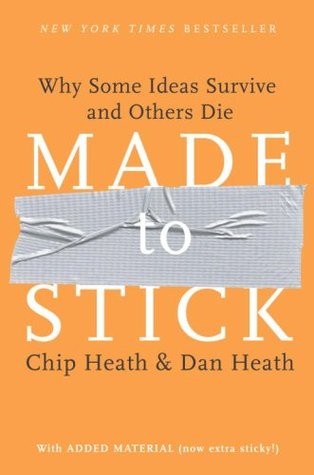
Chip and Dan Heath’s Made to Stick investigates a deceptively simple question: why do some ideas survive and spread while others, even important and well-researched ones, vanish almost immediately? Drawing on psychology, communications research, and a wealth of real-world examples ranging from urban legends to successful advertising campaigns to classroom teaching, the brothers argue that stickiness is not a matter of luck or raw talent — it follows identifiable principles that anyone can learn and apply. The book is written in an accessible, enthusiastic voice that itself models the principles it teaches, full of vivid anecdotes and surprising contrasts.
The Heath brothers organize their argument around a framework they call SUCCESs, an acronym standing for Simple, Unexpected, Concrete, Credentialed, Emotional, and Story. Each chapter unpacks one of these traits in depth, showing how ideas that stick tend to share these characteristics and how ideas that fail typically violate one or more of them. Along the way they introduce a key antagonist: the Curse of Knowledge, the cognitive bias that makes experts instinctively communicate in abstract, insider language that loses ordinary audiences. Overcoming this curse — learning to speak in concrete, human-centered terms even when you know a subject deeply — is presented as the central challenge for anyone trying to communicate effectively.
Key takeaways
-
The SUCCESs framework — Simple, Unexpected, Concrete, Credentialed, Emotional, Story — provides a practical checklist for diagnosing why an idea fails to land and how to redesign it so it sticks.
-
The Curse of Knowledge is the book’s most important villain: once you know something well, it becomes nearly impossible to remember what it felt like not to know it, leading communicators to strip out the very context and concreteness that audiences need.
-
Simplicity is about finding the core, not dumbing things down. The authors use the example of the U.S. Army’s “Commander’s Intent” — a single clear objective that guides all decisions — to show that ruthless prioritization actually amplifies impact rather than diminishing it.
-
Unexpectedness works by opening a gap in the audience’s knowledge and then promising to close it. Rather than leading with answers, sticky ideas often begin by surfacing a question or contradiction the listener didn’t know they had, triggering genuine curiosity.
-
Concreteness is the antidote to abstraction: ideas expressed in tangible, sensory, human-scale terms are far easier to understand, remember, and pass on. The authors contrast vague corporate mission statements with the electrifying specificity of John F. Kennedy’s moon-shot goal as an illustration of the difference concreteness makes.
-
Emotion and identity matter more than statistics: people are moved to act not primarily by data but by feeling something for someone. The “Don’t Mess with Texas” anti-littering campaign succeeded by reframing littering as a violation of Texan pride rather than an environmental statistic.
-
Stories function as flight simulators for the mind, allowing listeners to mentally rehearse situations and responses. The Heath brothers identify recurring narrative patterns — the Challenge plot, the Connection plot, and the Creativity plot — that help communicators choose story structures suited to the response they want to provoke.