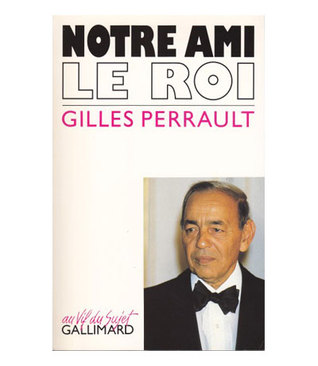
Gilles Perrault’s Notre Ami Le Roi is a scathing investigative indictment of Hassan II of Morocco and the special relationship his regime maintained with France. Published in 1990, the book caused an immediate diplomatic uproar, prompting the French government to distance itself from the text even as it topped bestseller lists. Perrault draws on extensive testimony, documents, and interviews to construct a portrait of a monarch whose public image as a modernizing, pro-Western leader masked a machinery of repression, torture, and enforced disappearance that operated for decades largely without scrutiny from his European allies.
The book’s central argument is one of complicity. Perrault does not merely catalogue the abuses of Hassan II’s security apparatus — the infamous detention centers, the fate of political prisoners who vanished into places like Derb Moulay Cherif or the desert prison of Kenitra — but insists on naming the Western governments, and France in particular, that enabled and excused them. The “friend” of the title is bitterly ironic: Hassan II was feted in Paris, welcomed at the Élysée, and treated as a pillar of stability in North Africa, while his subjects were being tortured in cellars. Perrault’s voice is that of the committed investigative journalist — methodical, indignant, and unsparing — building his case the way a prosecutor might, with testimonies of survivors and families of the disappeared forming the emotional core of the narrative.
Perrault also traces the long arc of Hassan II’s rule from his earliest years consolidating power after independence, through the coup attempts of 1971 and 1972 that nearly killed him, to the systematic crushing of leftist opposition, Saharan dissidents, and anyone perceived as a threat to the throne. The book became a landmark of human rights journalism in the French-speaking world and contributed to growing international pressure on Morocco, even as official France preferred to look the other way.
Key Takeaways
-
The “friendship” is a fiction of convenience: Perrault argues that France’s warm diplomatic and personal ties to Hassan II were sustained not by genuine affinity but by geopolitical interest — Morocco’s strategic position, its pro-Western alignment during the Cold War, and lucrative economic relationships that made human rights concerns an inconvenience to be suppressed.
-
Systematic torture and disappearance: The book documents in forensic detail the methods used by the Moroccan secret police — the DST and related organs — to eliminate opposition, including prolonged incommunicado detention, torture, and the phenomenon of the “disappeared,” individuals swallowed by the state with no official acknowledgment.
-
Survivors’ testimonies as the moral center: Perrault gives extended space to the accounts of former prisoners and the families of those who never returned, anchoring abstract political critique in specific human suffering and making the reader confront the cost of diplomatic silence.
-
The coup attempts transformed Hassan II: The near-successful military coups of 1971 (at Skhirat) and 1972 (the aerial attack on his plane) are presented as a turning point that made the king simultaneously more paranoid and more ruthless, accelerating the construction of a surveillance and repression state.
-
Western media and governments as enablers: A recurring theme is the failure of the French press and political class to report honestly on Morocco, accepting the official narrative of a benevolent modernizer and suppressing or ignoring testimony that contradicted it — a form of soft censorship driven by political and economic ties.
-
The Saharan dimension: Perrault addresses Morocco’s annexation of the Western Sahara and the brutal treatment of Sahrawi populations and dissidents, situating it within the broader pattern of a regime that defined any challenge to royal authority as an existential threat to be met with maximum force.
-
The book itself as a political act: The French government’s embarrassed reaction to publication — and Morocco’s fury — confirmed Perrault’s core thesis: the relationship between Paris and Rabat depended on a carefully maintained silence that his book shattered, demonstrating that naming complicity publicly still carried real diplomatic consequences.