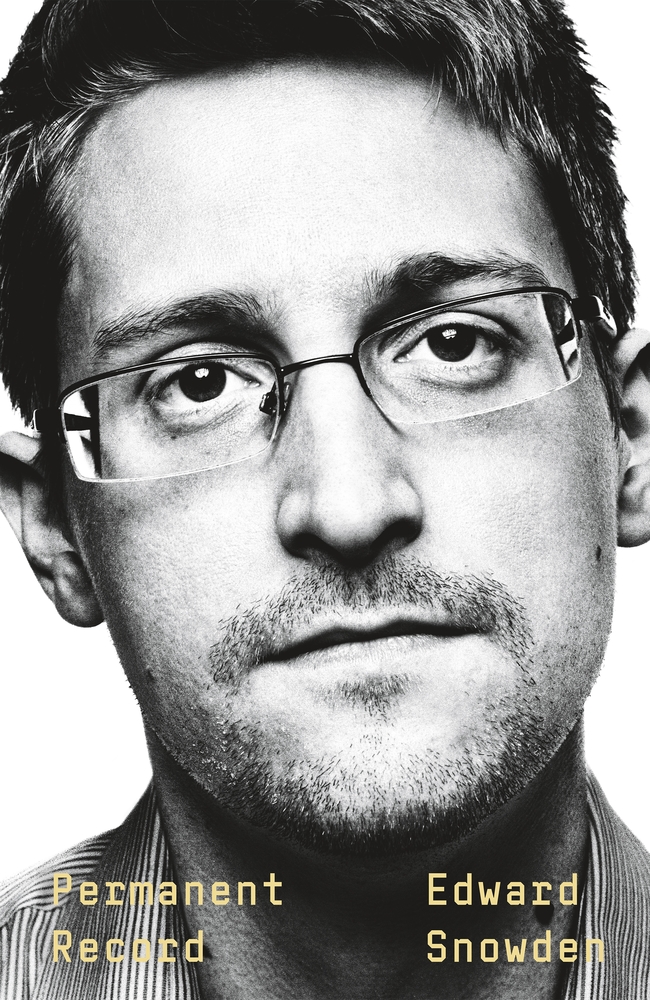
Edward Snowden’s Permanent Record is a memoir that traces his life from a childhood steeped in the culture of American government service to his emergence as one of the most consequential whistleblowers in modern history. Snowden grew up in the shadow of federal institutions — his father served in the Coast Guard, his mother worked for the NSA and later the federal courts — and he absorbed from an early age a deep, sincere belief in the ideals the United States claimed to represent. The book moves through his adolescence as a self-taught hacker and internet native, his enlistment in the Army Reserves after 9/11, and his rapid ascent through the intelligence community as a contractor for the CIA and NSA, where his technical gifts made him extraordinarily valuable and gave him unusually broad access to classified systems.
The second half of the book chronicles the gradual disillusionment that led Snowden to copy and ultimately leak a vast trove of NSA documents to journalists Glenn Greenwald and Laura Poitras in 2013. What he discovered — and what disturbed him beyond the point of silence — was that the NSA had built a global surveillance architecture capable of collecting and storing the communications of virtually everyone on Earth, including hundreds of millions of ordinary Americans, without individualized warrants or meaningful oversight. Snowden describes this program not as a targeted counterterrorism tool but as a fundamental, secret restructuring of the relationship between citizens and their government. His voice throughout is earnest and precise, carrying the slightly formal register of someone who learned to communicate primarily through screens and who takes constitutional principles with genuine, almost old-fashioned seriousness.
Permanent Record is also, quietly, a love story and a meditation on memory and identity in the digital age. Snowden devotes considerable space to his relationship with his partner Lindsay Mills, to the anguish of leaving her without warning when he flew to Hong Kong to meet the journalists, and to the strange suspended life he has lived in Moscow since receiving temporary asylum in Russia. The book’s title refers both to the fear instilled in children that bad behavior will follow them forever and to the literal permanent record the surveillance state now maintains on every person — a dossier assembled not by targeting suspects but by collecting everything from everyone, just in case.
Key takeaways
-
Mass surveillance is the default, not the exception. Snowden argues that the NSA’s programs — especially PRISM and upstream collection — were designed to collect bulk data on entire populations rather than to surveil specific suspects, representing a fundamental departure from the Fourth Amendment’s requirement of individualized suspicion.
-
Complicity is structural. Much of the intelligence community, Snowden contends, was kept ignorant of the full scope of what the NSA was doing through compartmentalization. Even conscientious employees could participate in building surveillance infrastructure without understanding its aggregate effect — a system designed to make individual moral accountability nearly impossible.
-
The internet changed the stakes of privacy permanently. Snowden traces how the shift from analog to digital life meant that the normal byproduct of living — communication, movement, commerce, curiosity — became a storable, searchable record. Surveillance no longer required effort; it required only retention.
-
Institutional loyalty and civic loyalty are not the same thing. Snowden frames his decision to leak as an act of fidelity to the Constitution rather than betrayal of his employers, drawing a distinction between the oath he swore to the document and the institutional cultures that, he argues, had quietly abandoned it.
-
Whistleblowing through legal channels was not a viable option. He details why internal reporting or using official whistleblower protections would have been ineffective or dangerous given the classified nature of the programs and the demonstrated treatment of prior intelligence-community whistleblowers.
-
Exile is its own kind of permanent record. The memoir’s final sections reflect on what it means to live indefinitely in a country he did not choose, cut off from family and from the culture that formed him, with no clear path home — the personal cost of his decision rendered in careful, unsparing detail.
-
Digital identity and selfhood are increasingly indistinguishable. Snowden weaves a philosophical thread throughout the book about how the self is now constituted in data, and how a government with access to that data has access to something more intimate than physical surveillance ever provided — not just what people do, but what they think, fear, and desire.