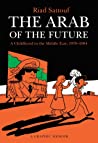
Riad Sattouf’s The Arab of the Future is a graphic memoir recounting his childhood as the son of a French mother and a Syrian father, moving between France, Libya, and Syria during the late 1970s and early 1980s. The book — the first volume of a multi-part series — traces the family’s migrations through the eyes of young Riad, a blond, wide-eyed child trying to make sense of radically different worlds. Sattouf renders this childhood with a deceptively simple, cartoon-like drawing style that captures both the warmth of memory and the strangeness of the environments he inhabits, from the manicured suburbs of Brittany to the dusty, impoverished village of his father’s family in rural Syria.
At the heart of the memoir is Riad’s father, Abdel-Razak Sattouf, a pan-Arab nationalist and academic whose idealism repeatedly collides with the realities of the societies he champions. He is a complicated, sometimes infuriating figure — charming and intellectually ambitious, yet capable of casual cruelty and self-delusion. Through the child’s innocent perspective, Sattouf avoids direct political editorializing, letting the contrast between his father’s grand rhetoric and the grinding poverty, authoritarianism, and social conservatism of Gaddafi’s Libya and Assad’s Syria speak for itself. The memoir is funny, tender, and quietly devastating, offering an intimate portrait of a family caught between cultures and ideologies, and a vivid document of a Middle East that has since been transformed by conflict.
Key takeaways
-
The child’s-eye view as political lens. By filtering everything through young Riad’s naive observations, Sattouf creates an ironic distance that is more effective than overt criticism. The boy accepts whatever he sees as normal, which makes the absurdities and injustices of authoritarian life all the more visible to the reader.
-
The father as emblem of pan-Arab failure. Abdel-Razak embodies a generation of educated Arabs who embraced secular nationalism as a modernizing force, yet whose personal behavior — paternalistic, sometimes violent, dismissive of women — contradicted those ideals. His trajectory illustrates how the dream of a unified, progressive Arab world was undermined from within.
-
Culture shock runs in every direction. The memoir resists a simple East-versus-West framework. Riad is an outsider everywhere: too Arab for France, too French (and too blond) for Libya and Syria. This perpetual foreignness gives the book its particular loneliness and its humor.
-
Women’s lives as a barometer of society. Riad’s French mother, Clémentine, gradually loses agency with each move eastward, her independence eroded by the expectations of Syrian village life and her husband’s accommodation of them. Female relatives in Syria appear as figures of confinement, their circumstances rendered with sympathy rather than condescension.
-
Visual style as emotional shorthand. Sattouf’s rounded, almost childlike line work — drawn in muted earth tones for the Middle East and cooler blues for France — does not merely illustrate the text; it encodes mood and memory. Violence and poverty appear in the same clean style as moments of joy, which makes both more affecting.
-
Poverty and authoritarianism rendered in mundane detail. Rather than grand historical statements, the book accumulates small observations: broken infrastructure, portraits of Hafez al-Assad plastered everywhere, the casual brutality of adults toward children, the scarcity of basic goods. This granular texture gives the memoir its documentary weight.
-
Identity as unresolved question. The title is deliberately ambiguous — “the Arab of the future” is what Riad’s father wants to make of him, a new kind of modern Arab man. But the memoir suggests this project is doomed, leaving Riad neither fully Arab nor fully French, an uncertainty that drives the entire multi-volume work.