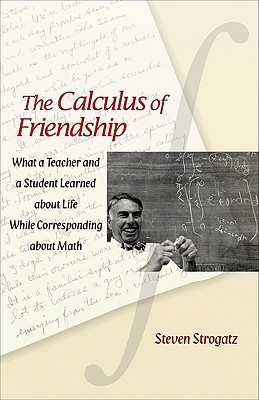
Steven Strogatz’s The Calculus of Friendship is a slim, deeply personal memoir built around the thirty-year correspondence between Strogatz, a mathematician at Cornell, and his high school calculus teacher, Don Joffray. The two began exchanging letters in the late 1970s, when Strogatz was a student at Loomis Chaffee and Joffray was the charismatic teacher who first showed him the beauty of mathematics. After Strogatz left for college and then a career in research, the letters continued — filled almost entirely with math problems, elegant puzzles, and shared discoveries — and the book weaves those exchanges together with Strogatz’s reflections on what the friendship meant and why, for so long, neither man could quite say so directly.
The central tension of the book is both mathematical and emotional. Strogatz comes to recognize that he and Joffray used calculus and problem-solving as a kind of emotional language — a way of staying close, expressing admiration, and avoiding the harder conversations about aging, loss, and what they meant to each other. As Joffray grows older and his health begins to decline, Strogatz starts to see the correspondence differently, mourning not only the friend he might lose but the younger version of himself who first fell in love with mathematics in Joffray’s classroom. The writing is warm and unguarded, combining accessible explanations of genuine mathematical beauty with the quieter register of a memoir about mentorship and time.
Key takeaways
-
Math as emotional proxy: Both men used problem-solving as their primary mode of connection, and Strogatz argues that for a certain kind of person — analytical, reserved — intellectual exchange can carry the full weight of love and friendship without ever stating it plainly.
-
The mentor-student arc: The book traces how the power dynamic between teacher and student slowly shifts; Strogatz eventually surpasses Joffray in technical ability, but this never diminishes his reverence, and Joffray’s gift was never technical mastery so much as infectious enthusiasm.
-
Mathematics as a living aesthetic experience: The letters reproduce real problems — involving chaos theory, infinite series, pursuit curves, and classical calculus — and Strogatz presents them not as pedagogy but as evidence that mathematical beauty is something felt, not just understood.
-
Avoidance and intimacy: A quiet psychological insight runs through the book: the men’s focus on problems served partly as avoidance of vulnerability, and Strogatz only fully grasps this when circumstances — illness, mortality — force the subtext into the open.
-
The particular loneliness of intellectual life: Strogatz reflects on how academic ambition and upward mobility can quietly erode the relationships that first made a discipline feel alive, and the letters with Joffray were, in part, his way of staying tethered to a more innocent relationship with math.
-
Grief and gratitude intertwined: The book builds toward an elegiac awareness that the friendship, and the form it took, belonged to a specific window in both men’s lives — and that recognizing something as precious often happens just as it begins to pass.