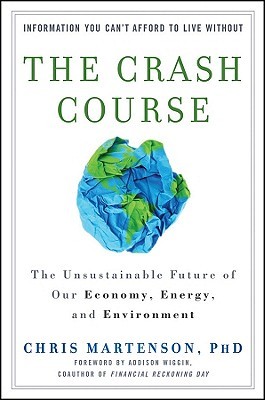
Chris Martenson’s The Crash Course: The Unsustainable Future of Our Economy, Energy, and Environment presents a sweeping, data-driven argument that the three great forces shaping modern civilization — the economy, energy supply, and the natural environment — are on a collision course that most people and institutions are not prepared to face. Originally developed as a free online video series before being expanded into book form, the work is aimed at a general audience and carries the urgent, plainspoken tone of someone who believes he has discovered something genuinely alarming and feels compelled to share it as widely as possible. Martenson, a scientist and former corporate executive turned economic analyst, writes not as a doom-monger but as a concerned citizen trying to give readers the conceptual tools to understand what is happening and why conventional wisdom is failing them.
The book’s central organizing insight is that we are living through a period of exponential growth in debt, resource consumption, and population — and that exponential growth on a finite planet cannot continue indefinitely. Martenson walks readers through the mathematics of compounding, showing how systems that appear stable can change with startling speed once growth curves bend sharply upward. He then applies this framework to the U.S. monetary system, arguing that the dollar is a debt-based currency whose integrity depends on perpetual economic expansion. When that expansion falters, the whole financial architecture becomes fragile. From there he moves into energy, and particularly the concept of Peak Oil — the idea that global petroleum production will reach a maximum and then irreversibly decline — arguing that cheap, abundant fossil fuels have been the hidden engine behind the prosperity of the last century and that no combination of alternative energies is ready to replace them at the scale required. Finally, he addresses environmental limits: soil depletion, water scarcity, fisheries collapse, and climate change, all of which he frames as additional constraints compressing the space in which the economy and energy system must operate.
Key takeaways
-
Exponential growth is the master key. Martenson repeatedly returns to the mathematics of compounding to show why linear intuitions mislead us: a system growing at a modest percentage rate can double in a surprisingly short time, and the final doubling consumes as many resources as all previous doublings combined. Understanding this dynamic reframes almost every trend discussed in the book.
-
Money is debt. In the current fractional-reserve banking system, nearly every dollar in existence was created as a loan and carries an interest obligation. This means the system structurally requires continuous growth just to service existing debt, making any steady-state or contracting economy inherently destabilizing to the financial system.
-
Peak Oil represents a civilizational inflection point. Martenson argues that liquid fossil fuels are uniquely energy-dense and versatile, and that global conventional oil production was near or past its peak at the time of writing. Because agriculture, transportation, manufacturing, and virtually all modern logistics depend on oil, a decline in supply — even a gradual one — would ripple through every sector of the economy.
-
Energy return on energy invested (EROEI) matters enormously. Not all energy sources are equal. Oil from a 1930s gusher might return a hundred units of energy for every one invested; tar sands or deep-water drilling might return only a few. As society is forced toward lower-EROEI sources, more of the economy must be devoted to simply acquiring energy, leaving less for everything else.
-
The three E’s are deeply intertwined. The book’s most important structural point is that the economy, energy, and the environment cannot be understood or fixed in isolation. Policies that stimulate economic growth accelerate resource depletion; cheaper energy temporarily masks financial fragility; environmental degradation raises the cost of food and water in ways that feed back into economic instability.
-
Conventional institutions are structurally blind to these problems. Governments, central banks, and corporations operate on short time horizons and have strong incentives to project optimism and defer hard choices. Martenson argues this means individuals cannot rely on authorities to warn them in time and must educate themselves and take personal preparatory action.
-
Resilience, not panic, is the appropriate response. Rather than predicting a specific date of collapse, Martenson urges readers to build personal and community resilience: reduce debt, develop practical skills, strengthen local food networks, and invest in tangible assets. The tone is pragmatic rather than apocalyptic, and he presents preparation as an empowering act rather than an admission of defeat.
The Crash Course is most persuasive as a primer on systems thinking and the hidden assumptions baked into modern economic life. Its critics note that some predictions — particularly around oil prices and the timing of financial crises — have not played out precisely as suggested, and that it underweights the adaptability of markets and the pace of renewable energy development. Nevertheless, the book remains a widely read introduction to the idea that growth-dependent systems face hard physical limits, and it succeeds in making complex financial and geological concepts accessible to readers with no specialist background.