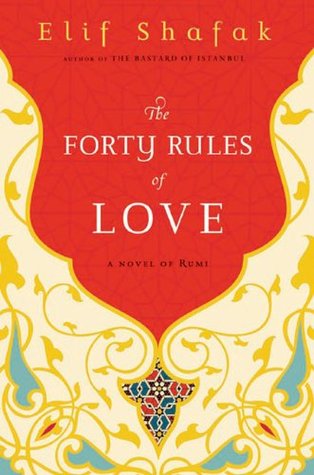
Elif Shafak’s The Forty Rules of Love is a novel that weaves together two love stories separated by eight centuries, exploring the transformative power of divine love, spiritual awakening, and the mystical traditions of Sufism. The contemporary narrative follows Ella Rubinstein, a suburban American housewife in her forties who feels emotionally adrift in a hollow marriage. Tasked with reading a manuscript for a literary agency, she finds herself drawn into the story within the story — a historical novel about the meeting between the revered Persian poet Jalal ad-Din Rumi and the wandering, unconventional dervish Shams of Tabriz. As Ella falls into an unexpected correspondence with the manuscript’s author, Aziz Zahara, the boundaries between her ordinary life and the luminous world of the text begin to dissolve.
The historical strand, set in thirteenth-century Konya and across the broader Islamic world, dramatizes the legendary bond between Rumi and Shams — a friendship so intense and spiritually electrifying that it scandalized the communities around them and ultimately transformed Rumi from a respected but conventional scholar into one of the world’s great mystical poets. Shafak gives voice to multiple narrators from Rumi’s circle, rendering the jealousy, devotion, and bewilderment of those who witnessed this extraordinary relationship. Her prose is warm, accessible, and unabashedly romantic, moving fluidly between the earthy chaos of medieval streets and the inner radiance of spiritual experience. She treats Sufism not as an obscure doctrine but as a living, breathing philosophy of love that speaks directly to the contemporary reader’s hungers.
The novel’s organizing spine is the forty rules of love themselves — aphorisms attributed to Shams of Tabriz that punctuate the narrative and articulate the Sufi path: the necessity of surrendering the ego, the sacredness of love in all its forms, the idea that the path to God runs straight through the heart of another human being. Shafak uses these rules not as rigid commandments but as windows, each one opening onto a scene or a transformation in one of her characters. The result is a novel that is part spiritual manual, part love story, and part meditation on what it means to truly be alive.
Key takeaways
-
Love as the highest spiritual path: Central to the novel’s philosophy is the Sufi conviction that divine love and human love are not opposites but the same force at different intensities. Shams teaches Rumi — and the reader — that loving another person completely and without conditions is itself a form of worship.
-
The transformative friendship of Rumi and Shams: Their bond is portrayed as a mutual annihilation of the ego, each man becoming more fully himself through the other. Shafak dramatizes how genuine spiritual encounter can look threatening and even scandalous to those who observe it from the outside.
-
Ella’s parallel awakening: The contemporary plot argues that spiritual and emotional rebirth are available to anyone, at any age, regardless of how settled or stagnant life has become. Ella’s story gives the historical material an accessible emotional anchor and universalizes its themes.
-
The rules of love as a living framework: The forty rules — including ideas such as “The past is an interpretation,” “Whatever happens in your life, no matter how troubling, do not enter the neighborhood of despair,” and “Real faith means having no fear of God but infinite love” — function as a portable Sufi wisdom tradition woven organically into the narrative.
-
Multiple perspectives on sanctity and outsiderdom: By giving chapters to minor characters — prostitutes, devout wives, jealous disciples — Shafak shows that spiritual insight is not the exclusive property of scholars or saints. The novel consistently honors those on the margins of respectable society.
-
The danger and necessity of the unconventional teacher: Shams is portrayed as deliberately provocative, flouting social norms to crack open complacency. The novel asks whether society, in protecting its institutions, too often destroys exactly the disruptive love it most needs.
-
East and West, past and present as mirrors: Shafak’s dual structure implies that the thirteenth-century Islamic world and twenty-first-century America are asking the same questions about meaning, belonging, and love — and that the answers Rumi found in the desert are just as available on a Connecticut cul-de-sac.