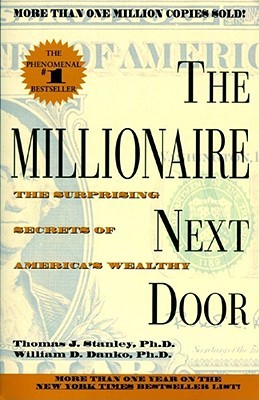
Thomas J. Stanley and William D. Danko’s research-driven classic overturns the popular image of the American millionaire as a flashy, high-spending elite. Drawing on decades of surveys and interviews with wealthy households across the United States, the authors reveal that most people with substantial net worth live in ordinary neighborhoods, drive used cars, shop at discount stores, and avoid ostentatious displays of wealth altogether. The millionaire next door, they argue, is far more likely to be a self-employed business owner in a mundane industry — a welder, a pest-control operator, a farmer — than a Wall Street banker or a celebrity. Wealth, in their telling, is almost always the quiet accumulation of disciplined saving and investing rather than the product of a high income alone.
The book’s central analytical framework contrasts two personality types: PAWs (Prodigious Accumulators of Wealth), who build net worth well above what their income would predict, and UAWs (Under Accumulators of Wealth), who earn well but spend nearly everything they make. Stanley and Danko find that many high-income professionals — doctors, lawyers, and corporate managers — fall into the UAW category because their lifestyles consume as much as, or more than, they earn. They maintain expensive homes in prestigious neighborhoods, pressure themselves to dress and drive in ways that signal success, and devote little energy to budgeting or investing. Meanwhile, the PAWs quietly compound wealth in the background, indifferent to social signaling. The authors’ voice is empirical and methodical, leaning heavily on survey data, but their prose carries an almost evangelizing conviction that ordinary financial discipline, practiced consistently over a lifetime, is within reach of far more Americans than commonly believe.
Key takeaways
-
Wealth is what you accumulate, not what you spend. The book’s foundational insight is that high income and high net worth are not the same thing. Many millionaires earn modest incomes but save aggressively over decades, while many six-figure earners remain financially fragile because their spending matches or exceeds their earnings.
-
Frugality is the common denominator. Across the surveys, self-made wealthy households share a consistent behavioral profile: they budget carefully, avoid consumer debt, negotiate hard on purchases, and treat spending as something to minimize rather than maximize. The ability to live well below one’s means is treated as a skill, not a deprivation.
-
Self-employment and business ownership are powerful wealth generators. A disproportionate share of American millionaires are self-employed small-business owners. Running your own business, even in an unglamorous sector, allows for greater control over income, expenses, and investment, and creates an asset that can appreciate independently of a salary.
-
The neighborhood you live in shapes your financial behavior. Choosing to live in an affluent neighborhood creates social pressure to consume at an affluent level. The authors argue that many high earners sabotage their wealth-building by selecting peer groups and zip codes that demand expensive lifestyle maintenance, crowding out saving.
-
“Economic outpatient care” undermines the next generation. Wealthy parents who habitually subsidize adult children’s lifestyles — paying off debts, gifting down payments, funding cars and vacations — tend to produce financially dependent offspring. Children who receive large financial gifts frequently accumulate less wealth than those who do not, because the subsidies reduce the urgency to earn, save, and manage money independently.
-
Time, energy, and money must be allocated deliberately. PAWs treat personal financial planning as a genuine activity worthy of scheduled time and attention. They know their net worth, track their spending, and set investment goals. UAWs, by contrast, spend disproportionate time and money on consumption and lifestyle maintenance while neglecting the financial planning that would actually build security.
-
The PAW formula offers a rough self-assessment benchmark. The authors propose a simple rule of thumb: multiply your age by your pre-tax annual income, then divide by ten. If your net worth substantially exceeds that number, you are likely a PAW; if it falls well short, you may be under-accumulating relative to your earning potential. The formula is deliberately rough, but it gives readers a concrete starting point for honest self-evaluation.