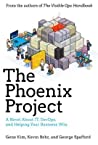
“The Phoenix Project” is a business novel that follows Bill Palmer, an IT manager at a fictional auto parts company called Parts Unlimited, who is unexpectedly promoted to VP of IT Operations. The company is in crisis: a massively important software initiative called the Phoenix Project is catastrophically late, the business is hemorrhaging money, and the IT department is drowning in unplanned work, outages, and firefighting. Told in a fast-paced, dramatic style, the book uses the narrative form to make abstract concepts around IT management, DevOps, and organizational dysfunction vivid and relatable. Bill must rescue the project — and the company — before the CEO shuts down the entire IT department and outsources it.
The authors, who bring decades of experience in IT operations and DevOps, model the story closely on Eliyahu Goldratt’s classic manufacturing novel “The Goal.” Bill is guided by a mysterious board member named Erik Reid, who introduces him to a set of principles drawn from lean manufacturing and theory of constraints. Through a series of crises, experiments, and hard-won victories, Bill and his team learn to see their work differently — not as a chaotic pile of tickets and emergencies, but as a flow of work through a system that can be understood, measured, and improved. The writing is deliberately accessible rather than literary; character depth is secondary to the clarity of the ideas being illustrated, making it more a teaching vehicle than a traditional novel.
The central argument of the book is that IT Operations, long treated as a cost center full of unpredictable complexity, can be managed with the same rigor and discipline as a factory floor. By identifying constraints, limiting work in progress, making work visible, and building feedback loops, IT organizations can achieve dramatically better outcomes — faster delivery, fewer failures, and a healthier working culture. The book is widely credited with helping popularize the DevOps movement and remains a canonical text for technology leaders grappling with organizational and delivery challenges.
Key takeaways
-
The Three Ways: The book’s organizing framework consists of three principles — flow (work moving efficiently from development to operations to customers), feedback (fast loops that surface problems early), and continual learning and experimentation. These “Three Ways” form the philosophical foundation of DevOps practice.
-
The four types of work: Erik teaches Bill to categorize all IT work into four types: business projects, internal IT projects, changes, and unplanned work. Unplanned work — the firefighting and emergency fixes — is the most dangerous because it is invisible, crowds out planned work, and compounds over time.
-
Constraints and the Theory of Constraints: Just as a factory has a bottleneck machine that limits the throughput of the entire plant, IT organizations have a single constraint that determines the pace of the whole system. Identifying and protecting that constraint — in the book it is embodied by the overloaded engineer Brent — is the key to improving flow rather than optimizing irrelevant parts of the system.
-
Work in progress (WIP) is the silent killer: One of the book’s most practical insights is that limiting work in progress is essential to improving throughput and reducing chaos. When too many projects are running simultaneously, context-switching, dependencies, and waiting time explode, causing everything to slow down and quality to collapse.
-
Making work visible: Much of the dysfunction at Parts Unlimited stems from the fact that work — and especially its status, volume, and dependencies — is invisible. Kanban boards and other visual management tools are presented not as bureaucratic overhead but as essential instruments for understanding and controlling a complex system.
-
IT and the business must be aligned: The novel dramatizes the damage caused when IT is seen as a back-office function rather than a strategic partner. When Bill begins to understand the business goals behind technical requests, and when business leaders begin to understand IT’s constraints, the relationship transforms and better outcomes follow for both sides.
-
Culture and safety matter as much as process: Through the character arcs of Bill’s team and his antagonistic colleague John the CISO, the book illustrates that sustainable improvement requires psychological safety, trust, and a willingness to experiment and fail without blame — not just the adoption of new tools or frameworks.