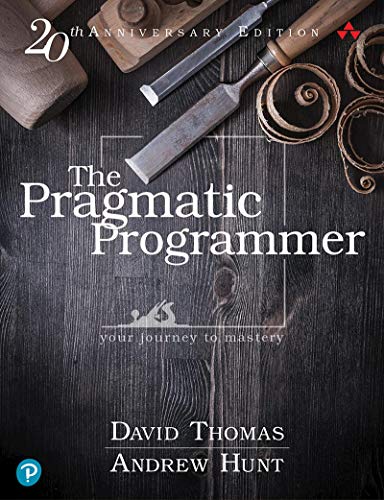
David Thomas and Andrew Hunt’s The Pragmatic Programmer is a landmark guide to software craftsmanship that has shaped how generations of developers think about their work. First published in 1999 and substantially revised in a 20th-anniversary edition in 2019, the book is less a technical manual than a philosophy of practice — a collection of hard-won wisdom about how to write better code, collaborate more effectively, and sustain a long, fulfilling career in software. The authors draw on their combined decades of experience to argue that great programming is not purely about mastering languages or frameworks, but about cultivating habits of mind: curiosity, rigorous thinking, personal responsibility, and a craftsman’s pride in the quality of one’s output.
The book’s structure is deliberately episodic. Rather than building a single linear argument, Thomas and Hunt present a series of self-contained tips and essays, each illuminating a particular facet of pragmatic thinking. The tone is collegial and direct — two seasoned practitioners sharing hard-learned lessons over coffee — and the prose is full of memorable metaphors and heuristics. The famous “broken windows” analogy (borrowed from criminology), the “rubber duck” debugging technique, the concept of orthogonality in system design, and the image of the “stone soup” collaborator all originate or were popularized here. Together, these ideas cohere into a portrait of the thoughtful, adaptable programmer who takes ownership of their craft rather than hiding behind process or tools.
Key takeaways
-
Take responsibility and avoid the “broken windows” trap. The authors argue that small acts of negligence — a messy codebase, an unaddressed bug, a tolerated shortcut — signal that no one cares, inviting further decay. Pragmatic programmers fix broken windows immediately and refuse to be the person who introduces the first one.
-
DRY: Don’t Repeat Yourself. One of the book’s most enduring principles holds that every piece of knowledge must have a single, unambiguous, authoritative representation within a system. Duplication — in code, documentation, or data — leads to inconsistency and maintenance nightmares, so ruthless deduplication is treated as a foundational discipline.
-
Orthogonality and decoupling. Systems should be designed so that components are independent: changing one should not cascade unexpectedly into others. This principle applies at every level, from architecture down to individual functions, and is presented as the key to systems that are easy to test, change, and reason about.
-
Tracer bullets and prototyping. Rather than designing everything up front, pragmatic programmers use “tracer bullet” development — building a thin, end-to-end slice of a system early to test assumptions and get fast feedback. Prototypes, by contrast, are explicitly throwaway explorations of specific risks, and the authors are insistent that team members must agree in advance that prototype code will not become production code.
-
Invest continuously in your knowledge portfolio. Thomas and Hunt frame a programmer’s skills as a financial portfolio requiring active management: learn one new language a year, read technical and non-technical books, engage with communities, and deliberately seek out uncomfortable unfamiliar territory. Knowledge has a half-life, and complacency is professional risk.
-
Communicate as carefully as you code. The book gives serious attention to written and verbal communication — how to write documentation, how to present ideas to teams and managers, how to listen actively. The quality of a programmer’s communication is treated as inseparable from the quality of their work, not a soft afterthought.
-
Use the power of plain text and automation. The authors advocate for plain text as the universal medium for data, configuration, and knowledge — it is human-readable, version-controllable, and tool-friendly across decades. Paired with this is a strong emphasis on automating repetitive tasks through shell scripts and build pipelines, freeing human attention for genuinely difficult problems.