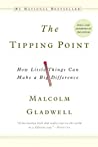
Malcolm Gladwell’s The Tipping Point explores a deceptively simple question: why do some ideas, products, and behaviors suddenly spread like epidemics while others fade into obscurity? Published in 2000, the book borrows the language of epidemiology to argue that social change is not gradual and linear but instead happens in dramatic, sudden bursts — at a “tipping point” where a trend crosses a threshold and explodes into mass adoption. Gladwell draws on an eclectic range of case studies, from the revival of Herschel Levine’s Hush Puppies shoes in the mid-1990s to the dramatic drop in New York City’s crime rate, to illustrate how small, precise interventions can trigger enormous change.
At the heart of the book is the idea that epidemics — social or otherwise — depend on a handful of identifiable factors. Gladwell identifies three rules that govern tipping points: the Law of the Few, the Stickiness Factor, and the Power of Context. Together, these principles explain not just how trends spread but why they are far more sensitive to environmental and social conditions than most people assume. Gladwell writes with an journalist’s instinct for narrative, weaving together social science research, psychology, and vivid storytelling to make abstract concepts feel immediate and concrete. His style is accessible and enthusiastic, occasionally prioritizing a compelling anecdote over methodological nuance.
Key takeaways
-
The Law of the Few holds that epidemics are driven disproportionately by a small number of exceptional people. Gladwell categorizes these into three types: Connectors (people with vast social networks), Mavens (information specialists who accumulate and share knowledge), and Salesmen (charismatic persuaders who get others to act). A trend often tips because it reaches the right person in one of these categories.
-
The Stickiness Factor describes the quality that makes a message memorable and actionable enough to prompt change. Stickiness is often achieved through surprisingly small tweaks — Gladwell uses the example of Sesame Street and Blue’s Clues to show how minor adjustments in presentation can radically improve how well children retain educational content.
-
The Power of Context argues that human behavior is far more sensitive to environment and circumstance than we like to believe. People are not simply driven by deep personality traits; they respond to subtle cues in their surroundings. The Broken Windows theory of policing — the idea that fixing small signs of disorder like graffiti can prevent larger crime — is offered as a real-world application of this principle.
-
The 150 Rule emerges from the Power of Context: Gladwell draws on anthropologist Robin Dunbar’s research to suggest that humans can maintain stable social relationships with roughly 150 people. Organizations and communities that stay below this size tend to be more cohesive and effective. Gore Associates, the company behind Gore-Tex, is cited as a business that deliberately caps its office sizes at 150 to preserve this dynamic.
-
Epidemics are more fragile and controllable than they appear. Because tipping points depend on specific people, specific messages, and specific contexts, they can be engineered — or stopped — by targeted, small-scale changes rather than massive, expensive interventions. This is one of the book’s most optimistic and provocative claims.
-
The book challenges the assumption of human consistency. A recurring theme is that situational factors overwhelm character. Gladwell revisits the famous Good Samaritan experiment, in which seminary students were far less likely to stop and help someone in distress when they were in a hurry, to argue that context shapes behavior in ways people systematically underestimate.