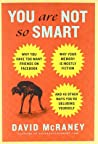
David McRaney’s You Are Not So Smart is a tour through the many ways human beings deceive themselves on a daily basis. Built on decades of research in psychology and behavioral economics, the book systematically dismantles the flattering story most people tell about their own minds — that they are rational, self-aware agents making deliberate choices based on accurate information. McRaney, who began the project as a blog, writes with the breezy, self-deprecating energy of someone who delights in catching himself in the same traps he’s describing. The tone is conversational and often funny, making the science accessible without dumbing it down.
Each chapter takes a single cognitive bias, logical fallacy, or self-delusion as its subject, opening with a “What you believe” versus “What is actually happening” framing before unpacking the psychology behind it. Topics range from the Dunning-Kruger effect and the bystander effect to procrastination, confabulation, and the illusion of transparency. McRaney draws heavily on landmark experiments — Milgram’s obedience studies, Festinger’s cognitive dissonance research, Cialdini’s work on persuasion — to show that the biases he describes are not character flaws of the ignorant but universal features of the human brain. The cumulative effect is humbling: by the end, readers have been shown, chapter by chapter, just how much of their inner life is confabulated after the fact rather than consciously authored.
What sets the book apart from a dry catalog of fallacies is McRaney’s insistence that self-delusion is not simply a bug to be patched. Many of these mental shortcuts evolved for good reasons and continue to serve useful purposes; the problem arises when we mistake the shortcut for clear-eyed reality. The book is less a self-help manual than an extended exercise in epistemic humility, nudging readers to hold their own certainties a little more loosely.
Key takeaways
-
The Dunning-Kruger effect cuts both ways. People with limited knowledge in a domain tend to overestimate their competence, while genuine experts often underestimate theirs — because expertise reveals how much there is still to know.
-
Confabulation is the norm, not the exception. The conscious mind routinely invents plausible-sounding explanations for behaviors and feelings that were actually generated by unconscious processes, then accepts those explanations as true memories or reasons.
-
Cognitive dissonance drives post-hoc rationalization. When our actions conflict with our beliefs, we are far more likely to quietly update our beliefs to match what we did than to feel genuine guilt and change our behavior — a mechanism that keeps self-image intact at the cost of accuracy.
-
The bystander effect scales with crowd size. The more people witness an emergency, the less likely any individual is to help, because each person assumes someone else will act and interprets the group’s inaction as a signal that no emergency exists.
-
Procrastination is an emotional regulation strategy, not a time-management failure. People delay not because they are lazy but because starting a task triggers anxiety or self-doubt; avoidance provides immediate relief even as it worsens long-term outcomes.
-
Priming and framing shape judgment invisibly. Irrelevant environmental cues — the order in which options are presented, the words used to describe identical outcomes — reliably alter decisions in ways people never notice and would firmly deny if asked.
-
Awareness of a bias does not reliably neutralize it. Knowing about the confirmation bias, the halo effect, or the sunk-cost fallacy makes people feel more sophisticated but rarely interrupts the automatic processes that produce those errors in the first place.