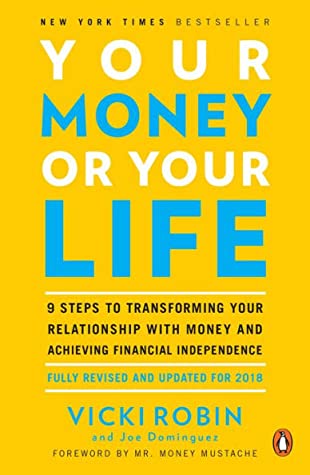
Vicki Robin’s Your Money or Your Life, co-authored with Joe Dominguez and later updated by Robin, is a foundational personal finance book that reframes the entire question of money. Rather than offering tips for budgeting or investing, it challenges readers to examine the relationship between their time, energy, and spending. The central argument is deceptively simple: money is something you trade your life energy for, and most people are making that trade unconsciously, accumulating expenses and obligations that keep them locked in work they may not value. The book asks readers to calculate their real hourly wage — accounting for commute time, work-related costs, and recovery time — and then evaluate every purchase in terms of how many hours of life it actually costs.
The book’s tone is part philosophical manifesto, part practical workbook. Robin writes with warmth and moral seriousness, drawing on her own experience and that of thousands of seminar participants who transformed their financial lives by following the program’s nine steps. The steps move from tracking every cent of income and expenditure to creating a detailed monthly “wall chart” of spending versus income, gradually identifying the point of “enough” — what the authors call the “crossover point,” where investment income meets monthly expenses and paid work becomes optional. The book sits at the intersection of financial independence, environmental consciousness, and meaning-making, arguing that overconsumption is not just personally destructive but ecologically irresponsible.
What distinguishes Your Money or Your Life from conventional personal finance writing is its insistence that financial decisions are fundamentally ethical and existential decisions. Robin does not promise wealth or luxury; she promises clarity and freedom. The book encourages readers to define their own values before deciding how to spend or save, and it treats frugality not as deprivation but as a form of alignment between what you say matters and how you actually live.
Key takeaways
-
Money equals life energy. Every dollar spent represents a portion of your finite time on earth. Calculating your true hourly wage — after taxes, commuting, work clothes, stress-recovery time, and other hidden costs — often reveals that you earn far less per real hour than you assume, making each purchase feel weightier.
-
The “crossover point” is the goal. The program’s endpoint is the moment when monthly investment income equals monthly expenses. At that point, paid employment becomes a choice rather than a necessity — the foundation of what is now called financial independence or “FI.”
-
Tracking everything transforms awareness. The book prescribes recording every single financial transaction in meticulous detail, not to judge yourself but to see clearly. Many readers report that the act of tracking alone — without any rule about what to change — naturally reduces spending as unconscious habits become visible.
-
“Enough” is a radical concept. Consumer culture promotes “more” as the default, but Robin argues there is a point of genuine enough — a level of comfort and security beyond which additional spending yields diminishing or even negative returns on fulfillment. Identifying your personal “enough” is treated as both a practical and spiritual exercise.
-
Frugality is alignment, not deprivation. The book reframes saving money as an expression of values rather than self-punishment. When spending is evaluated against what you genuinely care about, cutting expenses that don’t serve your real life feels liberating rather than restrictive.
-
Work and identity are dangerously entangled. Robin argues that many people define themselves through their jobs and their consumption, making it psychologically difficult to step back from either. Disentangling your sense of self from your career and your purchases is presented as a prerequisite for genuine financial and personal freedom.
-
Financial independence has an environmental dimension. The book links personal overconsumption to broader ecological harm, suggesting that choosing to consume less is not only a path to freedom but also a form of social responsibility. Living lightly is framed as both a personal and collective good.